Troubleshooting
Why your tension rod sags in the middle, and what a center support does
A tension rod sags in the middle because it bends like a beam under the curtain, and that bending grows with the fourth power of the span: about four times the sag for every 41 percent more length. More tension at the ends does not straighten it. Less weight, a shorter or stiffer span, or a center support does – and from about 8 feet a center support or a bracket rod is the honest advice.
Disclosure: This page contains affiliate links (marked with *). If you buy through them, we earn a small commission at no extra cost to you. As an Amazon Associate I earn from qualifying purchases. Learn more
The short version
First check that it is sag, not slipping: the ends stay put and only the middle bows. Then lighten or spread the load, choose a rod whose range puts your width well inside it, and prefer a stated thicker tube for wide spans. From about 8 feet add a center support or switch to a bracket rod. Tightening the rod sets grip, not stiffness.
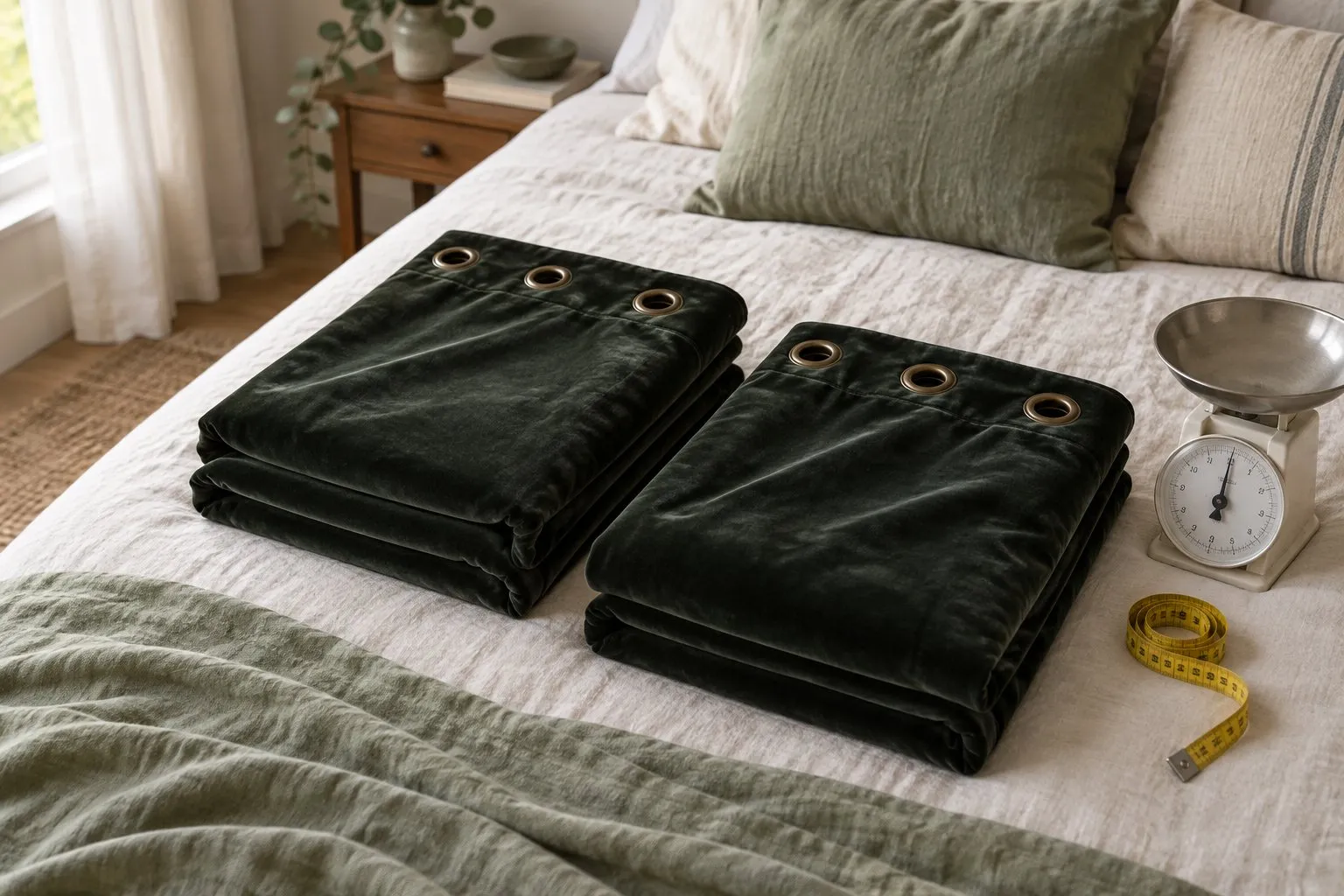
A tension rod has two jobs. Its ends must grip, and its tube must stay straight between them. A sagging rod has failed at the second job only. That matters, because the fixes for slipping (cleaner surfaces, more tension) do nothing for sag, and the fixes for sag do little for slipping.
Sag or slipping? Tell them apart first
| What you see | What it is | Where to look |
|---|---|---|
| Ends stay in place, the middle bows down | Sag: the tube bends under the load | This page |
| One end creeps down the wall, the rod tilts | Slipping: too little grip at that end | Why a tension rod keeps falling |
| The rod gets shorter, then drops | Threaded sections unscrewing | The falling-rod page, threaded rods |
| The rod stays bent after you take the curtain off | Permanent bend: the tube has yielded | Replace the rod |
Why a rod sags: the fourth-power rule
A rod held at both ends with a curtain spread along it behaves like a beam under a uniform load. Its sag follows δ = 5wL⁴/(384EI): w is the load per foot and L the span; below the line sit the stiffness of the material and a measure of the tube's cross-section. Three things follow from it.
- Span dominates. Length enters with the fourth power. About 41 percent more span means about four times the sag with the same curtain per foot. A rod that looks straight at 5 feet can bow visibly at 7 and badly at 10.
- Weight counts in a straight line. Twice the curtain weight per foot, twice the sag.
- The tube helps, but less than the span hurts. A thicker tube or a stiffer material lowers the sag. Diameter fights sag; it does not add grip.
The formula is a ratio tool, not a rating. It assumes one uniform tube, and a telescoping rod is two tubes, one sliding inside the other. The inner tube is necessarily the thinner one, and the further you extend the rod, the more of the span it carries and the shorter the overlap where the two tubes support each other. Bob Vila reported exactly this kind of behaviour: its TEECK rod bowed when fully extended, and the article recommends choosing a rod longer than the space you measured.
The fix, step by step
Check that it is sag
Look at both ends. If the end caps sit where you set them and only the middle bows, it is sag. If an end has moved, fix the grip first.Weigh the curtain
Put the panels on a bathroom or kitchen scale. Compare the figure with the maker's rating, if there is one. Umbra, for example, states 15 lb for its Anywhere rod; many makers state none, ALLZONE for its AZ02L among them. There is no standard load capacity.Lighten or spread the load
Swap lined or blackout panels for lighter fabric, or hang them on a stronger rod. Open curtains collect in a bundle; if that bundle sits in the middle, the middle carries most of the weight. Draw open curtains to the ends, where the rod is supported.Shorten the working length
Choose a rod whose range puts your width well inside it rather than at the very end. Keeping away from the end of the range is common advice for spring rods, not a manufacturer rule, but it also keeps more overlap between the two tubes.Use a stiffer tube for wide spans
For wide openings, prefer a rod whose maker states a larger diameter. ALLZONE states 1.25 inches for its AZ02L; most window rods name no diameter at all.Add a center support from about 8 feet
A support in the middle halves the free span, and because sag grows with the fourth power, that cuts it dramatically. If you cannot fit one, a bracket-mounted rod is the better choice for that window.
What a center support does, and how it fits
A center support turns one long span into two short ones. Since sag scales with the fourth power of the span, two halves sag only a small fraction of what the whole length did. That is why ALLZONE ships its 123 to 160 inch AZ01XL with a central support bracket, and why Kwik-Hang, a maker of no-drill curtain brackets, recommends center supports for windows wider than 60 inches and two of them from 120 inches on its bracket rods.
The catch for a tension rod is that a support needs something to hang from or stand on. ALLZONE does not describe on its collection page how its central bracket attaches, so check the instructions in the box. A support that screws into the wall or the head jamb gives up the no-drill idea; a no-drill trim bracket only works where there is suitable wooden trim. If neither is possible, keep the span short or the fabric light. Long and extra-long tension rods shows how sag adds up span by span, and the 120-inch tension rod page covers rods for 8 to 10 foot openings.
When to call a professional
If the rod has bent the window frame, pushed a jamb out of line or cracked tile or drywall at the end caps, stop using it there. Have the frame or wall checked before you mount anything new. If you switch to a screwed bracket rod, mounting into drywall or tile needs the right anchors or blocking; follow the rod maker's instructions or ask a handyman.
When a new rod makes sense
Replace the rod when it stays bent with no curtain on it, when your width sits at the very end of its range, or when the curtain you want is simply too heavy for a thin tube over that span. For wide windows a thick rod with a stated diameter and a lock is the logical step up; our heavy-duty tension rod comparison explains what “heavy duty” does and does not mean.
ALLZONE
ALLZONE AZ02L 83–123 in
A thick 1.25-inch spring tension rod with a pin lock for wide window openings from about 7 to 10 feet.
Why here: For openings of 83 to 123 inches ALLZONE documents a 1.25-inch pole and a pin lock, and sells a 123–160 inch version with a central support bracket. It states no weight rating.
Best for: Wide inside-mount windows, patio-door alcoves and room dividers between 83 and 123 inches
- 1.25-inch pole diameter per ALLZONE – a stiff tube for a long span
- Pin-lock length setting (ALLZONE: “Advanced Lock in System”) instead of a twist-only thread
- ALLZONE sells the same rod family from 28 to 160 inches, so the range can be matched to the opening
- ALLZONE publishes no weight rating – keep heavy blackout panels in mind
- Starts at 83 inches: useless for normal-width windows
- Out of stock in ALLZONE’s own shop on 22 Oct 2026 (Amazon listing available)
- Width range
- 83–123 in
- Mechanism
- Spring tension + pin lock
- Diameter
- 1.25 in
- Material / finish
- Black or white (material not stated)
- Stated load
- Not stated by ALLZONE
- Data from
- Manufacturer page
How much a rod can carry in the first place is a separate question, answered on how much weight a tension rod can hold. Back to the tension curtain rod overview.
Questions people ask
How do I stop a tension rod from sagging?
Reduce the load in the middle, shorten the span or use a stiffer rod. In practice: weigh the curtain and swap heavy panels for lighter ones, choose a rod whose range does not end at your width, prefer a tube with a stated larger diameter, and from about 8 feet add a center support or use a bracket-mounted rod. Tightening the ends only adds grip.
Will a thicker tension rod sag less?
Yes. A thicker tube is stiffer, so it bends less under the same curtain over the same span. It does not grip better: whether the rod slips depends on the outward force at the end caps and the surface they press on. ALLZONE states a 1.25-inch pole for its AZ02L, Umbra a 1-inch rod for its Anywhere.
How long can a tension rod be before it needs a center support?
No maker publishes a span limit for tension rods. Because sag grows with the fourth power of the span, from about 8 feet a center support or a bracket rod is the honest advice. ALLZONE ships its 123 to 160 inch AZ01XL with a central support bracket, and Kwik-Hang recommends center supports above 60 inches for its bracket-mounted rods.
Sources
- ALLZONE: curtain rod collection, AZ01XL 123–160 in “with Central Support Bracket Included” (read 22 Oct 2026)
- ALLZONE: AZ02L, 83–123 in, 1.25-inch pole diameter, pin lock (product page, read 22 Oct 2026)
- Umbra: Anywhere curtain rod, 1-inch rod, max capacity 15 lb (product page, read 22 Oct 2026)
- Kwik-Hang: FAQ – center support brackets recommended for windows wider than 60 inches (read 22 Oct 2026)
- Bob Vila: The Best Shower Curtain Rods – the TEECK rod bowed when fully extended (updated 28 Jan 2026)
Keep reading
- Buying guideLong rodsLong tension rods reach about 13.75 feet in listings, but sag grows with the fourth power of the span. When a long rod works, when it needs support, and our pick.
- Buying guide84–120 inch rods84 to 120 inch tension rods: which ranges cover 8, 10 and 12 ft, why 120 inches sits at the end of most ranges, when to add a center support, and our pick.
- Buying guideHeavy-duty rods“Heavy duty” on a tension rod is a sales word, not a rating. What to check instead – diameter, lock, stated load and span – plus our pick for wide windows.
- TroubleshootingRod keeps fallingA shower or window tension rod that keeps falling usually has a surface, force or load problem. Find the cause, fix it step by step, and know when to replace it.
- Question & answerHow much weight can a tension rod hold?There is no standard load capacity for tension rods. What manufacturers actually state, from 7 to 30 lb, why width matters, and how to check your own curtain.
Who researches this
tensioncurtainrod.com Editorial Team
Tension rods for windows, showers and closets
We are the editorial team at tensioncurtainrod.com. We compare what rod makers actually publish – width ranges, mechanisms, materials, warranty wording and the rare load rating – with what listings and AI answers claim, and we say where the two disagree. We do not run lab tests, and we say so openly.
- Manufacturer pages & warranty wording read
- Seller-only data labeled
- No lab tests – stated openly
- Publisher details in the imprint