Buying guide
Tension rods for blackout curtains: weigh the panels first, then pick the rod
A tension rod can hold blackout curtains, but they are among the heaviest panels you can hang on one, and most rod makers publish no weight rating. Weigh the panels first, keep the span as short as the window allows, and choose a rod with a thick tube and a lock. For wide windows of 83 to 123 inches our pick is the ALLZONE AZ02L. Expect some light at the edges: an inside-mount rod keeps the curtain within the frame.
Disclosure: This page contains affiliate links (marked with *). If you buy through them, we earn a small commission at no extra cost to you. As an Amazon Associate I earn from qualifying purchases. Learn more
The short version
Weigh the blackout panels with their rings or clips on a bathroom or kitchen scale, then compare with what the rod's maker states – most state nothing. For 83 to 123 inches we recommend the ALLZONE AZ02L with its 1.25-inch tube and pin lock; ALLZONE says it suits heavy drapes but gives no rating. A tension rod sits inside the frame, so light still leaks around the edges.
On this page
- Our pick for wide windows with blackout panels
- Which rod for which blackout window?
- Step 1: weigh the panels
- Step 2: keep the span honest
- Step 3: accept the light gap, or plan around it
- Rods for blackout curtains compared
- The seller-data options one by one
- Typical mistakes with blackout curtains on tension rods
- Our recommendation
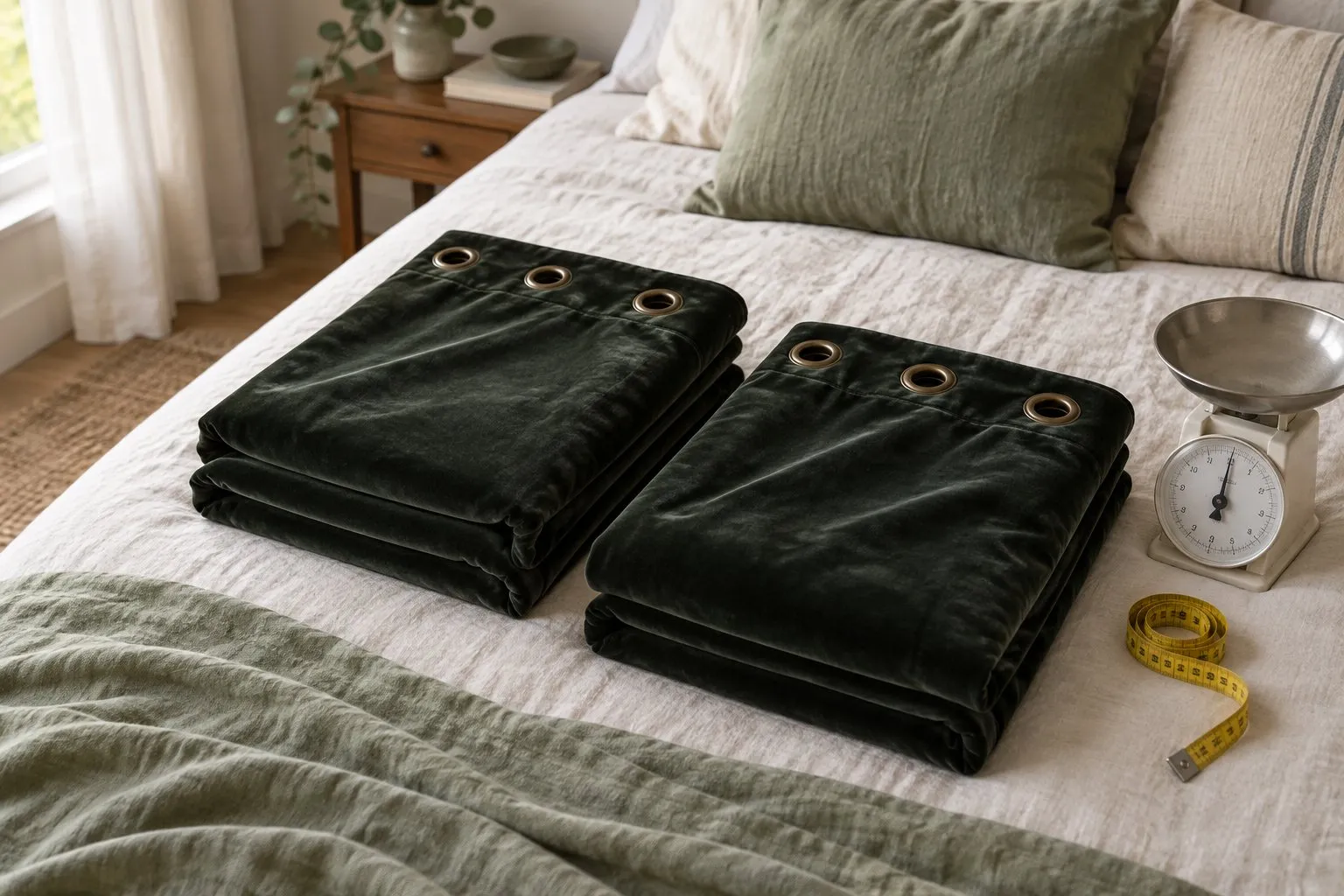
Blackout curtains are the hard case for a tension rod. They are dense, often lined or coated, and they hang in pairs across the whole window. The rod has no screws: it stays up only because its end caps press outward and friction at the caps carries the load. So the question “can a tension rod hold blackout curtains?” comes down to three numbers you can check – the panel weight, the span and what the rod's maker states – plus one limit you cannot change: where a tension rod sits.
Our pick for wide windows with blackout panels
ALLZONE
ALLZONE AZ02L 83–123 in
A thick 1.25-inch spring tension rod with a pin lock for wide window openings from about 7 to 10 feet.
Why here: ALLZONE documents a 1.25-inch pole and a pin lock for the AZ02L and says it suits both lightweight and heavy drapes – but publishes no weight rating.
Best for: Wide inside-mount windows, patio-door alcoves and room dividers between 83 and 123 inches
- 1.25-inch pole diameter per ALLZONE – a stiff tube for a long span
- Pin-lock length setting (ALLZONE: “Advanced Lock in System”) instead of a twist-only thread
- ALLZONE sells the same rod family from 28 to 160 inches, so the range can be matched to the opening
- ALLZONE publishes no weight rating – keep heavy blackout panels in mind
- Starts at 83 inches: useless for normal-width windows
- Out of stock in ALLZONE’s own shop on 22 Oct 2026 (Amazon listing available)
- Width range
- 83–123 in
- Mechanism
- Spring tension + pin lock
- Diameter
- 1.25 in
- Material / finish
- Black or white (material not stated)
- Stated load
- Not stated by ALLZONE
- Data from
- Manufacturer page
For windows and alcoves of 83 to 123 inches the ALLZONE AZ02L is the rod we recommend for heavy panels. ALLZONE names a “sturdy 1.25-inch pole diameter”, a pin-lock length setting and use with heavy drapes. A thick tube sags less under a heavy curtain; the lock keeps the length from creeping. What ALLZONE does not give is a load figure, so the panel weight is still yours to check. On 22 October 2026 ALLZONE's own shop listed the rod as sold out; the Amazon listing was available.
The catch is the starting width: 83 inches. Most bedroom windows are narrower. ALLZONE sells a heavy-duty AZ02M for 42 to 83 inches on its own site, which we have not matched to an Amazon listing. For ordinary window widths, the rods below are seller-data options.
Which rod for which blackout window?
Which rod for which opening?
If your window is 83 to 123 inches wide → ALLZONE AZ02L 83–123 in
View(paid link to Amazon, opens in a new tab)Ad · paid link · check price & delivery on AmazonIf the window is an ordinary 3 to 6 feet
If the span is 7 to 10 feet
If you do not know what your curtains weigh
Step 1: weigh the panels
No source gives a reliable weight for “a blackout curtain”: fabric, lining, size and rings vary too much. Your own panels are the only figure you can trust.
Weigh everything that will hang
Fold both panels with their rings, clips or hooks and put them on a bathroom or kitchen scale. Add a valance or a second layer if it will hang on the same rod.Compare with the maker's rating
If the rod's maker states a capacity, stay below it. Umbra, for example, states a maximum of 15 lb for its Anywhere rod – a figure for that rod only. There is no standard load capacity for tension rods, and ALLZONE states none for the AZ02L.Decide on the span
If there is no rating, the span is your main lever: the shorter the rod, the less it sags and the less it is asked to carry.
Step 2: keep the span honest
A rod held at both ends bends under a load spread along its length, and the sag grows with the fourth power of the span (δ = 5wL⁴/(384EI)). With the same tube and the same curtain per foot, a 72-inch window sags about 2.7 times as much as a 56-inch one, and an 84-inch window about five times as much. Heavy blackout panels make that visible quickly. From about 8 feet a center support or a bracket-mounted rod is the honest advice. More on bowing rods is on our tension rod sagging page.
Step 3: accept the light gap, or plan around it
A tension rod can only be mounted inside an opening, never on a flat wall or outside the frame. The curtain therefore hangs within the window, and light passes along the edges and over the top. Deconovo, a blackout-curtain maker, writes that an inside mount leaves part of the frame visible and that for blocking light it only works when paired with a separate blackout shade behind the curtain; for bedrooms it recommends an outside mount with the curtain extending past the frame on each side.
What that means for you:
- Room-darkening is realistic, total darkness is not with a tension rod alone.
- Use the full width. Panels whose combined width is clearly wider than the opening close without a center gap.
- Add a shade behind the curtain if the room must be dark. Shades on tension rods are covered on our tension rod blinds and shades page.
- Need an outside mount? Then a tension rod is the wrong tool; see what to use instead of a tension rod.
Rods for blackout curtains compared
| Comparison | Our pick for wide windowsALLZONE AZ02L 83–123 in | Seller data onlyEZFurni 42–123 in | Seller data onlySTARLATTA 1.1 in, 31–120 in | Seller data onlyHeavy-duty rod 41–86 in |
|---|---|---|---|---|
| Width range | 83–123 in | 42–123 in | 31–120 in | 41–86 in |
| Mechanism | Spring tension + pin lock | Tension | Tension | Tension |
| Diameter | 1.25 in | Not stated | 1.1 in | Not stated |
| Material / finish | Black or white (material not stated) | Not stated | Matte black | Not stated |
| Stated load | Not stated by ALLZONE | Not stated | Not stated | 150 lb claimed in the title (unverified) |
| Data from | Manufacturer page | Amazon listing title only | Amazon listing title only | Amazon listing title only |
| Best for | Wide inside-mount windows, patio-door alcoves and room dividers between 83 and 123 inches | Wide windows and room dividers when the opening is under 83 inches, too short for the ALLZONE AZ02L | Long openings when you want one rod to cover almost any width | Windows and patio openings of 41 to 86 inches – with the load claim treated as advertising |
| On Amazon(paid link to Amazon, opens in a new tab)Ad · paid link · check price & delivery on Amazon | On Amazon(paid link to Amazon, opens in a new tab)Ad · paid link · check price & delivery on Amazon | On Amazon(paid link to Amazon, opens in a new tab)Ad · paid link · check price & delivery on Amazon | On Amazon(paid link to Amazon, opens in a new tab)Ad · paid link · check price & delivery on Amazon |
Only the ALLZONE row comes from a maker page. The other rows repeat the Amazon listing titles; “Not stated” means we found no figure.
The seller-data options one by one
None of these rods has a manufacturer page we could read. They fill the widths below 83 inches, but they are options, not picks.
EZFurni 42–123 in
The EZFurni rod* covers 42 to 123 inches, so a 5 to 7 foot window sits near the middle of its range rather than at an end. Diameter, material and load are not stated. For heavy panels, that wide range is its main argument.
STARLATTA 1.1 in, 31–120 in
The STARLATTA rod* names a 1.1-inch diameter in its title – a useful detail against sag – in matte black, which suits dark blackout fabric. The listing is young, and “heavy duty” comes without a load figure.
The 41–86 inch rod that claims 150 lb
This listing puts “150Lb” in its title. We found no test, data sheet or manufacturer page behind the figure, so it is an unverified listing claim. The rod's range itself, 41 to 86 inches, fits many bedroom windows; plan with your scale, not with the title.
EZFurni
EZFurni 42–123 in
A long tension rod that reaches from about 3½ to 10 feet.
Seller data only
Best for: Wide windows and room dividers when the opening is under 83 inches, too short for the ALLZONE AZ02L
STARLATTA
STARLATTA 1.1 in, 31–120 in
A 1.1-inch matte-black tension rod with a very wide 31–120 inch range.
Seller data only
Best for: Long openings when you want one rod to cover almost any width
Typical mistakes with blackout curtains on tension rods
- Hanging two layers on one rod. A sheer plus a blackout panel doubles the load on the same span.
- Planning with a title figure. “Heavy duty” or “150 lb” in a listing is not a rating anyone has shown how to measure.
- End caps on soft trim. Pressure sits on two small pads. Vinyl or MDF trim, drywall and fresh paint can show marks, and the heavier the curtain, the more force the rod needs.
- Expecting total darkness. An inside mount leaves edge gaps by design.
- Using the full length of a wide-range rod. At the long end of its range a rod has the least overlap between its tubes.
If a rod with heavy panels keeps sliding, the causes are usually the surface and the force, not the curtain alone – why tension rods keep falling goes through each fix.
Rod finder
Question 1 of 4
Where does the rod go?
A tension rod needs two solid, opposing surfaces.
Our recommendation
For blackout curtains across a wide window of 83 to 123 inches, we recommend the ALLZONE AZ02L: ALLZONE documents its 1.25-inch tube and pin lock and says it suits heavy drapes. It states no weight rating, so weigh the panels first and keep the span as short as the window allows. For narrower windows, a seller-data rod with a range that puts your width near its middle is the practical choice. For thick panels in general, our heavy-duty tension rod guide compares diameter, locks and stated loads.
Questions people ask
Can tension rods hold blackout curtains?
Often yes, within limits you have to check yourself. Blackout panels carry a coating or a lining and weigh more than sheers. Weigh the pair, keep the span short, and set the end caps on a flat, solid jamb. If the rod's maker states a rating, stay below it. Most makers, including ALLZONE for the AZ02L, state none, so a short span and a thick, locking tube are your safety margin.
Can a tension rod hold blackout curtains across an 84-inch window?
It can, but 84 inches is a wide span for heavy panels. Sag grows with the fourth power of the span, so an 84-inch rod sags about five times as much as a 56-inch one under the same curtain per foot. Choose a rod whose range covers 84 inches comfortably, such as a 42–123 inch rod, or the ALLZONE AZ02L if your width is at least 83 inches, and weigh the panels first.
Do blackout curtains on a tension rod block all light?
No. A tension rod can only be mounted inside the window frame, so the curtain hangs within the opening and light passes along the edges. Deconovo, a curtain maker, notes that an inside mount leaves part of the frame visible and recommends pairing it with a blackout shade. For a fully dark room an outside-mounted rod with panels wider than the frame does better.
What about the tension rods that claim 150 lb?
One listing in our comparison puts “150Lb” in its title for a 41–86 inch rod. We found no test, data sheet or manufacturer page behind it, so we treat it as an unverified listing claim. Do not plan heavy blackout panels around that number; weigh the curtain and keep the span short instead.
Sources
- ALLZONE: AZ02L Heavy Duty Tension Curtain Rod, 83–123 in, 1.25-inch pole, pin lock, “lightweight and heavy drapes” (product page, read 22 Oct 2026)
- ALLZONE: curtain rod collection, AZ02M 42–83 in and further ranges (read 22 Oct 2026)
- Deconovo: inside vs outside mount for blackout curtains (curtain maker guide, read 22 Oct 2026)
- Umbra: Anywhere curtain rod, max capacity 15 lb (product page, read 22 Oct 2026)
- Engineering ToolBox: beam deflection, uniform load on a simply supported beam (read 22 Oct 2026)
Keep reading
- Buying guideHeavy-duty rods“Heavy duty” on a tension rod is a sales word, not a rating. What to check instead – diameter, lock, stated load and span – plus our pick for wide windows.
- Question & answerHow much weight can a tension rod hold?There is no standard load capacity for tension rods. What manufacturers actually state, from 7 to 30 lb, why width matters, and how to check your own curtain.
- Buying guideRods for windowsA tension rod for a window sits inside the frame: how to check width and frame depth, what vinyl frames need, and which window tension rods fit which opening.
- TroubleshootingRod saggingA tension rod that sags in the middle has a span and load problem, not a grip problem. Why long rods bow, how to fix it, and when a center support is needed.
- Buying guide84–120 inch rods84 to 120 inch tension rods: which ranges cover 8, 10 and 12 ft, why 120 inches sits at the end of most ranges, when to add a center support, and our pick.
- Buying guideBest curtain rodsThe best tension curtain rod depends on width and curtain weight. Our pick for wide windows, honest options for ordinary windows, and what the makers really state.
Who researches this
tensioncurtainrod.com Editorial Team
Tension rods for windows, showers and closets
We are the editorial team at tensioncurtainrod.com. We compare what rod makers actually publish – width ranges, mechanisms, materials, warranty wording and the rare load rating – with what listings and AI answers claim, and we say where the two disagree. We do not run lab tests, and we say so openly.
- Manufacturer pages & warranty wording read
- Seller-only data labeled
- No lab tests – stated openly
- Publisher details in the imprint