Compatibility
Shower curtain rods for sloped ceilings: when a tension rod works in an attic bathroom
Often yes. A tension rod spans from one wall to the opposite wall and never touches the ceiling, so a sloped ceiling only matters where it cuts into the space the rod and the curtain need. If both end walls are flat, solid and tiled at your rod height, a straight tension rod works under a slope like anywhere else. If one end of the opening has no wall at that height, you need a lower rod or a fixed solution.
Disclosure: This page contains affiliate links (marked with *). If you buy through them, we earn a small commission at no extra cost to you. As an Amazon Associate I earn from qualifying purchases. Learn more
The short version
A tension shower rod works under a sloped ceiling when both end walls reach your chosen rod height with a flat, solid surface, and the slope leaves room above the rod for the hooks. Measure the width at that exact height. If the slope forces the rod lower, use a shorter curtain. If one end has no wall at all, a tension rod cannot hold; consider a fixed or ceiling-supported rod and ask its maker about angled ceilings.
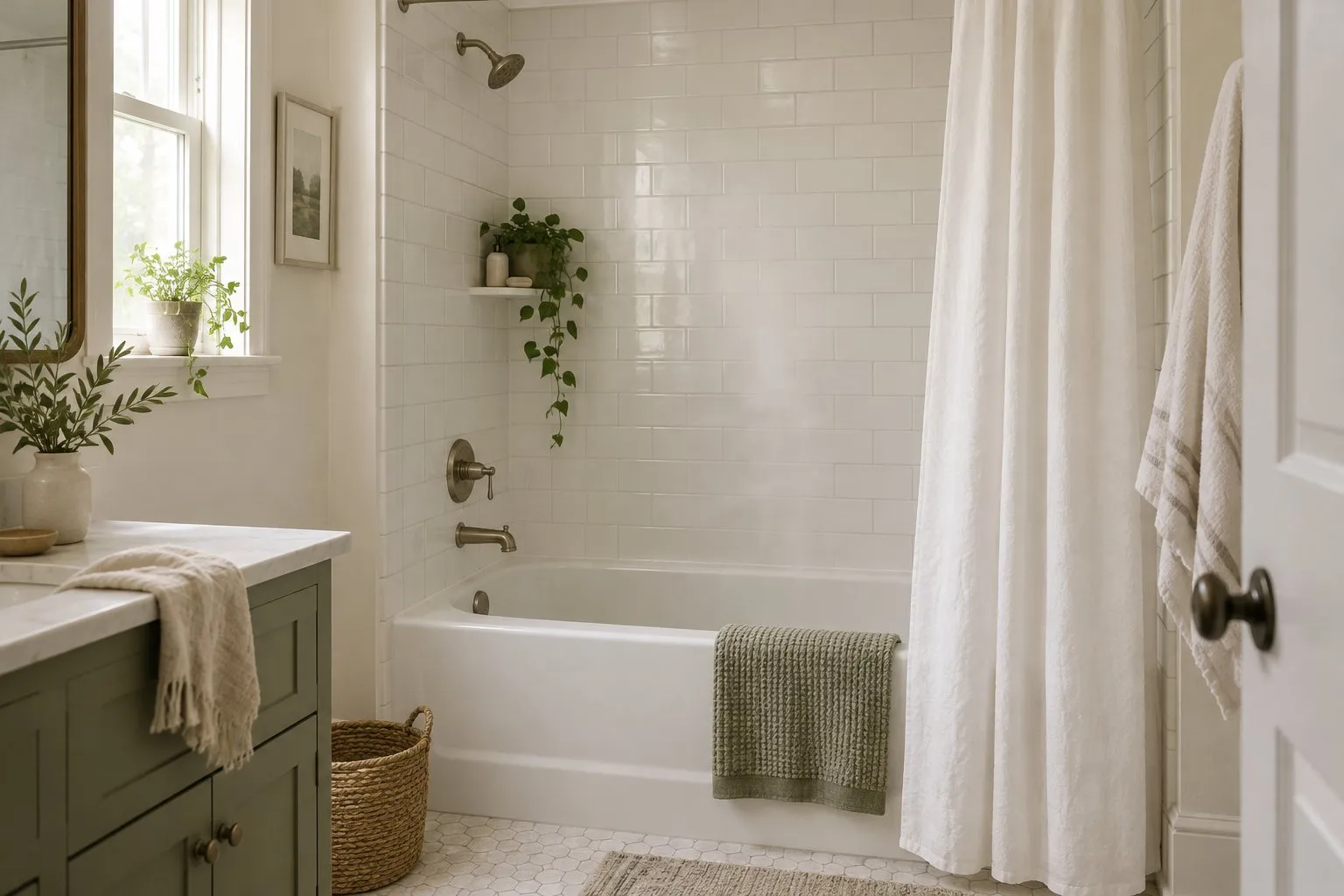
A tension rod is an adjustable rod without brackets that stays between two opposing surfaces, such as the walls of a shower, because a spring or a twist/lock mechanism presses its rubber end caps outward; friction at the end caps carries the load. The ceiling is not part of that. Moen's installation sheet for its tension shower rod has three steps: place one end at the desired height on the wall, expand the rod to the other side, twist to lock. So the question under a sloped ceiling is not “does the rod work?” but “is there a pair of walls at the height I need?”
Which attic layouts work
| Layout under the slope | Tension rod? | What decides |
|---|---|---|
| Tub along the low knee wall, curtain line at the room side, end walls on both sides | Usually yes | The end walls are tallest at the room side, where the rod sits; check they reach your rod height there |
| Slope runs along the rod: one end wall full height, the other end low | Sometimes | The rod must sit below the point where the low end still has a wall, with room for the hooks above |
| Opening with a wall at one end only, the other end open under the slope | No | A tension rod needs two opposing surfaces; use a fixed or ceiling-supported rod |
| Curtain has to turn a corner as well | No | See corner and L-shaped shower curtain rods |
| Dormer shower with flat, tiled side walls | Yes | Treat it like an ordinary alcove |
How to check your bathroom
- Find the rod height you want. Rod height follows from the curtain length, the drop of the hooks or rings and the gap above the floor. Moen calls the height personal preference and gives the example of a rod at 78 inches with a 72-inch curtain, which hangs about 6 inches above the floor. Our shower curtain rod height guide works through the sum.
- Check both end walls at that height, exactly where the curtain line runs, usually above the outer edge of the tub. Under a slope the wall height changes from front to back, so measure at the right depth.
- Leave room above the rod. The hooks or rings sit on top of the rod and need to slide freely under the slope.
- Measure the width at that height at least twice and use the smaller figure. It must fall inside the rod's printed range; the tension rod sizes guide explains why.
- Check the surface. Each end cap needs a flat, solid face, ideally tile. In attic bathrooms the tile often stops lower than in a standard alcove; if the cap would press on painted drywall, read tension rods on tile first.
If the slope forces the rod lower
A lower rod is the simplest fix, but the curtain has to match. Pepper Home's size guide lists the common shower curtain lengths of 72 and 84 inches and suggests measuring from the rod to the floor, then allowing 8 to 10 inches for the rings. If your rod has to sit well below the usual height, a standard 72-inch curtain may reach the floor or the tub bottom; look for a shorter curtain or have one hemmed. Keep the rod level: on a rod that runs downhill, the rings slide toward the low end.
If one end has no wall
Then a tension rod is the wrong tool, however good. The usual alternatives are a rod fixed to the one wall plus a ceiling support, or a ceiling-mounted curtain track. Be careful with ceiling supports on a slope: Kingston Brass describes its 36-inch supports as ceiling mounts and says nothing about angled ceilings, and Bob Vila notes that one hoop rod's ceiling mount “will become unstable unless mounted flush”. Ask the maker whether its support works on your angle, and have it fixed into solid framing; a handyman can find the rafters and seal the holes. How fixed and tension rods compare in general is in tension vs fixed shower curtain rods.
Our pick for a straight opening under a slope
Moen
Moen TR1000 straight
A straight tension shower rod from a plumbing brand that you lengthen, then turn three times to lock.
Why here: A straight tension rod for 44 to 72 inches with a spec sheet and a three-step, tool-free installation – useful where you have to try a few heights before the walls and the slope agree.
Best for: Straight tub and shower openings of about 5 to 6 feet when you want a maker with a written warranty
- Moen: “expand the shower rod to the desired length and turn it three times to lock it in place” – no tools
- Limited lifetime warranty (Moen)
- Decorative covers hide the mounting hardware; several finishes
- Fits 44–72 in only (Moen spec sheet) – measure before you buy
- No load rating stated by Moen
- Upper price class for a tension rod
- Width range
- 44–72 in (Moen spec sheet)
- Mechanism
- Twist to lock (FastLock)
- Diameter
- 1 in
- Material / finish
- Type 201 stainless rod, type 430 covers; bronzed gold
- Stated load
- Not stated by Moen
- Data from
- Manufacturer page
Moen's spec sheet gives the TR1000 a 1-inch rod and a range of 44 to 72 inches; installation is extend, then twist to lock. Moen states no load rating, so keep the rod to the curtain and liner. More straight and curved rods are on the tension shower curtain rod overview.
Questions people ask
Can you use a tension shower rod with a slanted ceiling?
Yes, as long as the rod has two opposing walls to press against at the height you need. The ceiling plays no part in how a tension rod holds; the end caps press outward against the walls. What the slope can do is lower the highest point at which both walls are still there, which may force a lower rod and a shorter curtain.
Does a shower rod have to be level under a sloped ceiling?
Keep it level. A tension rod is installed horizontally from wall to wall, and Moen's instructions set the first end at the desired height and expand the rod to the other side. On a rod that runs downhill, curtain rings and hooks tend to slide toward the low end. Use a spirit level or measure the same height from the tub rim on both walls.
Can I mount a ceiling support for a shower rod on a sloped ceiling?
The ceiling-support product pages we read, for example Kingston Brass's 36-inch supports, describe a ceiling mount but say nothing about angled ceilings, and Bob Vila notes that one hoop rod's ceiling mount becomes unstable unless mounted flush. Ask the maker before you buy one for a slope, and have it installed into solid framing.
Sources
- Moen: INS10040 Decorative Tension Shower Rod installation instruction sheet – place one side at the desired height, expand to the other side (PDF, read 22 Oct 2026)
- Moen: What height should my shower rod be installed? (support article, read 22 Oct 2026)
- Pepper Home: Shower curtain size guide – 72 and 84 inch lengths, rod-to-floor measurement (curtain maker, read 22 Oct 2026)
- Kingston Brass: CCS341 shower curtain rod ceiling support – ceiling mount, no statement on angled ceilings (product data, read 22 Oct 2026)
- Bob Vila: The Best Shower Curtain Rods – a hoop rod's ceiling mount “will become unstable unless mounted flush” (updated 28 Jan 2026, read 22 Oct 2026)
- Moen: TR1000 Decorative Tension Rod technical specification – 44–72 in, 1 in rod (PDF, read 22 Oct 2026)
Keep reading
- OverviewShower rodsTension shower curtain rods explained: measure wall to wall, straight or curved, what “never rust” really covers, and why a shower rod slips – with our picks.
- ExplainerRod heightHow high should a shower curtain rod be? Work it out from curtain length, hooks and floor gap – plus what a tension rod needs there: flat tile on both walls.
- CompatibilityTension rods on tileDoes a tension shower rod work on tile? Yes – on flat glazed tile, away from grout lines, caulk and trim tiles. What fits, what does not, how to check.
- CompatibilityCorner and L-shaped rodsCan an L-shaped or corner shower curtain rod be a tension rod? No – a rod that turns a corner has no two opposing walls. What works instead and how to measure.
- ComparisonTension vs fixed rodsTension or fixed (wall-mounted) shower curtain rod? Compare install, load, fit and walls – and when drilling into tile is worth it. With our tension-rod pick.
Who researches this
tensioncurtainrod.com Editorial Team
Tension rods for windows, showers and closets
We are the editorial team at tensioncurtainrod.com. We compare what rod makers actually publish – width ranges, mechanisms, materials, warranty wording and the rare load rating – with what listings and AI answers claim, and we say where the two disagree. We do not run lab tests, and we say so openly.
- Manufacturer pages & warranty wording read
- Seller-only data labeled
- No lab tests – stated openly
- Publisher details in the imprint