Troubleshooting
Rusty shower rod: why “rustproof” rods still stain, and what to do
A shower rod rusts when iron meets water and the protection is gone: a plated steel tube whose coating is scratched, a steel spring or screw inside an aluminum rod, or iron particles left on stainless steel. Brown spots on stainless steel can also be tea staining from chlorides such as bleach cleaners. Find out which one you have; the fix and the next rod depend on it.
Disclosure: This page contains affiliate links (marked with *). If you buy through them, we earn a small commission at no extra cost to you. As an Amazon Associate I earn from qualifying purchases. Learn more
The short version
Check where the rust sits. Rust along a plated steel tube means the coating is breached, so replace the rod. Rust only at the ends usually comes from steel springs or screws. Brown staining on stainless steel often comes from bleach or other chloride cleaners and can be cleaned. For the next rod, aluminum or stainless steel, wiped dry and cleaned without bleach.
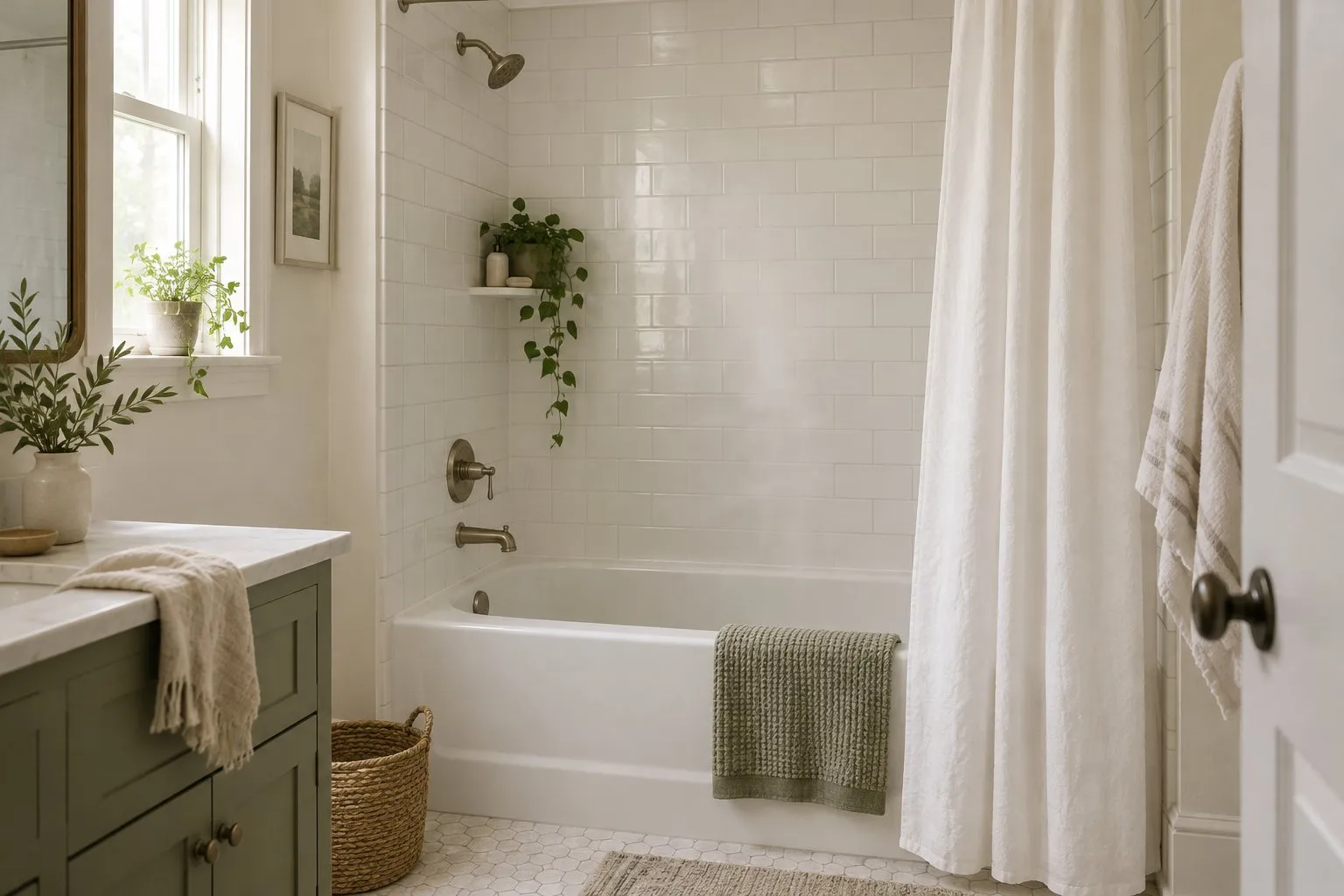
A bathroom is about the worst place for iron: warm, wet, and cleaned with products that contain chlorine. Whether a rod rusts depends on what it is made of and on every small steel part inside it. The label on the box often tells you less than you think.
Symptom → likely cause
| What you see | Likely cause | What to do |
|---|---|---|
| Rust spots or flaking along the whole tube | Plated or coated steel with a breached finish | Replace the rod; the core keeps rusting |
| Rust only at the ends or at the joint | Steel spring, screws or end hardware inside the rod | Wipe the joint dry; replace if rust runs onto the curtain |
| Brown halo or streaks on a stainless rod | Tea staining from chlorides (bleach, salt) or iron particles | Clean as below; stop using bleach on the rod |
| White powder or dull film on an aluminum rod | Aluminum oxidation, not rust | Clean with a damp cloth; harmless to the rod's function |
| Orange marks after scrubbing | Steel wool or a steel brush left iron on the surface | Remove the particles; use nylon pads instead |
Why “rustproof” is not a promise
Many shower rods are sold as “rustproof” or “never rust”. Treat those words as the maker's wording with a scope, not as a guarantee for every part.
- Aluminum contains no iron and cannot form red rust. Zenna Home's NeverRust warranty, as quoted by retailers, promises that the rods stay free from red rust for the original purchaser's lifetime. It does not cover white oxidation, pitting or the steel springs and screws.
- Stainless steel is not one material. Moen's spec sheets show this well: its curved CSR2172 uses type 304 stainless steel in chrome and brushed nickel and type 430 in Old World Bronze, its straight TR1000 rod type 201. 304 is very resistant in a ventilated bathroom but can tea-stain where chlorides concentrate; 316 resists better. Euro Inox recommends molybdenum-alloyed grades of the 316 family wherever noticeable amounts of chlorides are expected.
- Coated or plated steel is protected only as long as the coating is intact. A scratch from a shower ring is enough to let water reach the steel.
Euro Inox describes tea staining as tiny corrosion pits, often surrounded by a brownish halo, that form under deposits when chlorides are not cleaned off. On a shower rod, the usual chloride sources are bleach-based bathroom cleaners and, near the coast, salt air.
How to clean a stained rod, step by step
Find out what the rod is made of
Check the box, the instructions or the maker's spec sheet. Aluminum, stainless steel and plated steel need different care, and a plated rod with rust coming through is not worth cleaning.Start with water and a soft cloth
Moen tells you to clean its tension rod only with a soft damp cloth, dry it well and avoid commercial or abrasive cleaners. That removes soap film and light deposits from any material.For light staining on stainless steel, use a mild cream cleaner
Euro Inox names gentle, non-scratching household cream cleaners and domestic stainless steel cleaners for mild staining. Rinse with clean water afterwards and dry the rod.Never use bleach, steel wool or a steel brush
Euro Inox lists hypochlorite bleaches and chloride-containing cleaners among the agents not to use on stainless steel. Steel wool and wire brushes leave carbon steel particles on the surface, which turn into rust spots when wet.For stubborn rust stains, follow the product directions
Euro Inox describes phosphoric acid cleaners for moderate rust staining. Acid cleaners can damage aluminum and stone, so keep them off aluminum rods and natural stone tile, and use them exactly as the supplier directs.Dry the rod after showers
Wiping the rod and the joint dry once in a while keeps water from standing at the overlap, where springs and screws sit.
When a new rod makes sense
Replace the rod when the tube itself is rusting, when rust from the joint stains your curtain, or when a rusted spring has lost force and the rod starts to slip; for slipping, see why tension rods keep falling. The two material choices for wet rooms are compared in aluminum vs stainless shower rods.
For a curved rod we recommend Zenna Home's aluminum tension rod, with the NeverRust scope in mind:
Zenna Home
Zenna Home curved 50–72 in
An aluminum curved shower rod that holds by tension across the usual 50 to 72 inches of a tub alcove.
Why here: Aluminum cannot form red rust, and Zenna's NeverRust warranty covers red rust for the original purchaser's lifetime – within its stated scope.
Best for: Standard tub alcoves where you want more elbow room without drilling
- Adjusts from 50 to 72 inches – a far wider window than Moen’s 57–60 in curved rod
- Aluminum: the NeverRust warranty promises no red rust for the original purchaser’s lifetime
- The curve moves the curtain away from you in the tub
- “Never rust” covers red rust only – not white oxidation, pitting or steel screws and springs
- No load rating published
- A curved rod has more parts to fit than a straight one; plan two people for installation
- Width range
- 50–72 in
- Mechanism
- Tension mount, curved
- Diameter
- Not stated
- Material / finish
- Aluminum (NeverRust line)
- Stated load
- Not stated
- Data from
- Manufacturer + retailer pages
For a straight rod, look for a named stainless steel grade. The industrial-style rod below names 304 stainless steel in its listing title; that is seller data only:
Industrial 304 stainless tension rod, 43–72 in*More straight stainless rods are on our stainless steel tension shower rod page. All shower rods, sorted by type and maker data, are in the best tension shower curtain rods comparison, and the basics of fit and rust are in the tension shower curtain rod guide.
Questions people ask
Why is my “rustproof” shower rod rusting?
Because the label usually covers less than it seems. Zenna Home's NeverRust warranty, as retailers quote it, promises no red rust on the aluminum rod; it does not cover white oxidation, pitting or steel springs and screws. A plated steel rod is protected only while the plating is intact. And stainless steel can tea-stain where chlorides from bleach or salt collect.
Can I use bleach to clean a shower rod?
Not on stainless steel. Euro Inox, the European stainless steel association, lists hypochlorite bleaches and chloride-containing cleaners among the agents that should not be used on stainless steel, and says to rinse them off with plenty of fresh water if they get on it. Moen asks for a soft damp cloth only on its tension rod.
Does aluminum rust?
Aluminum contains no iron, so it cannot form red rust. It can still oxidise white, and an aluminum rod can contain steel parts, such as a spring or screws, that do rust. Rust at the ends of an aluminum rod usually comes from those parts.
Should I replace a rusty shower rod?
Replace it when the rust comes from the tube itself: flaking plating, rust along the length or rust seeping out of the joint that stains the curtain. Light brown staining on stainless steel and white film on aluminum can usually be cleaned. A rod whose spring has rusted may also have lost force, which makes it slip.
Sources
- Euro Inox: Cleaning Architectural Stainless Steel (Building Series vol. 15) – cleaning agents not to use, iron contamination, tea staining (PDF, read 22 Oct 2026)
- Moen: TR1000 technical specification – 201 stainless steel rod; clean only with a soft damp cloth, dry well (spec sheet, read 22 Oct 2026)
- Moen: CSR2172 technical specification – type 304 and type 430 stainless steel rods (spec sheet, read 22 Oct 2026)
- Zenna Home: curved shower rods, “Rustproof” tension rods 50 to 72 in (read 22 Oct 2026)
Keep reading
- OverviewShower rodsTension shower curtain rods explained: measure wall to wall, straight or curved, what “never rust” really covers, and why a shower rod slips – with our picks.
- ComparisonAluminum vs. stainlessAluminum cannot form red rust; 304 stainless can tea-stain near chlorides. What “never rust” covers, why steel parts matter, and which shower rod to pick.
- Buying guideStainless shower rodsStainless steel tension shower rods compared: why the grade matters (304 vs 430), where aluminum wins, what “never rust” covers, and our rust-resistant pick.
- Buying guideBest shower rodsBest tension shower curtain rods by job: Moen's twist-to-lock straight rod, a curved aluminum rod, 304 stainless and budget rods – with what each maker states.
- BrandZenna Home rodsZenna Home tension shower rods explained: curved and straight models, the 50–72 inch range, what “NeverRust” covers, and which Zenna rod fits your alcove.
Who researches this
tensioncurtainrod.com Editorial Team
Tension rods for windows, showers and closets
We are the editorial team at tensioncurtainrod.com. We compare what rod makers actually publish – width ranges, mechanisms, materials, warranty wording and the rare load rating – with what listings and AI answers claim, and we say where the two disagree. We do not run lab tests, and we say so openly.
- Manufacturer pages & warranty wording read
- Seller-only data labeled
- No lab tests – stated openly
- Publisher details in the imprint