Troubleshooting
Why your tension rod keeps falling, and the fix for each cause
A tension rod falls when the friction at its end caps is smaller than the load. Almost always one of five things is behind it: a surface the caps cannot grip (grout, caulk, wet or fresh paint), too little outward force, a width at the end of the range, threaded sections that slowly unscrew, or extra weight such as wet towels. Each cause has its own fix.
Disclosure: This page contains affiliate links (marked with *). If you buy through them, we earn a small commission at no extra cost to you. As an Amazon Associate I earn from qualifying purchases. Learn more
The short version
Clean and dry both contact points and set the end caps on a flat surface, not a grout line or caulk bead. Extend the rod a little past the opening so it is under real tension, keep your width inside the stated range, and hang nothing extra on it. If a threaded rod keeps shortening itself, a small screw through the overlap can stop it; on a spring rod it does nothing.
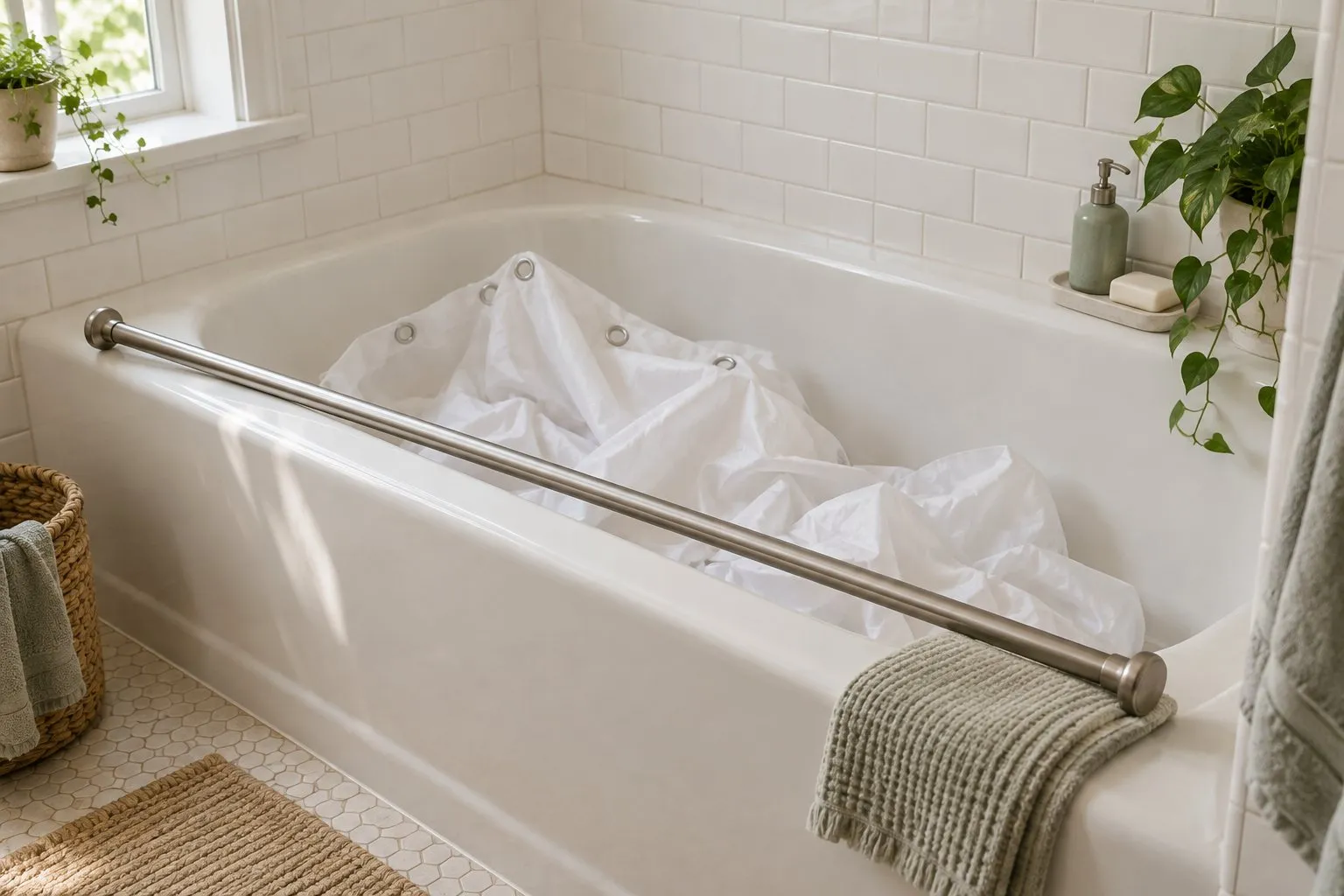
A tension rod has no screws and no brackets. It stays up only because its end caps press outward against two surfaces and friction at the caps is larger than the weight pulling down. When it falls, one side of that balance has changed: less grip, less force, or more load. Find which one, and the fix is usually quick.
Symptom → likely cause
| What you notice | Most likely cause | Fix |
|---|---|---|
| Rod slides down slowly over days | Wet, soapy or glossy surface; spring losing force | Clean and dry the contact points; re-tension; check the range |
| Rod drops suddenly when you pull the curtain | Too little outward force; caps on a grout line or caulk bead | Extend the rod past the opening before fitting; move the caps to a flat face |
| Rod gets shorter and finally drops | Threaded sections unscrewing against each other | Re-tighten; a screw through the overlap on threaded rods only |
| Rod bows, then pops out | Load too heavy for the span | Remove towels and extras; shorter span or a center support |
| Rod falls right after installing | Width at the very end of the range | A rod whose range puts your width further inside |
The fix, step by step
Take the rod down and look at the caps
Check that both rubber end caps are complete, not cracked or hardened, and sit straight on the tube. Damaged caps give little grip; if the maker does not sell replacement caps, replace the rod.Clean and dry the contact points
Wipe soap film and moisture off both spots on the wall or jamb and let them dry fully. In a shower, do this when the room is dry, not right after a hot shower.Choose a flat, solid spot
Place the caps on a flat tile face, not across a grout line, a caulk bead or a rounded trim edge. On painted walls, fresh paint needs time to cure before it can take the pressure.Set real tension
Extend the rod slightly longer than the opening, compress it into place and level it. On a twist or lock rod, tighten or lock it as the maker describes; Moen, for example, tells you to extend its TR1000 rod and turn it three times to lock.Reduce the load
Hang only the curtain, and the liner if needed. Remove towels, hooks and caddies. A curtain and liner that soak up water get heavier.Check the next day
If the rod has moved, note which way: sliding down points to grip or force, getting shorter points to unscrewing threads, bowing points to load and span.
The screw trick, and where it ends
A popular fix is to drill a small hole through the overlap of the two tube sections and drive in a screw. The Grit and Polish explains why it worked on their rod: it had a threaded connection, and the screw stops the two sections from twisting relative to each other, so the rod cannot shorten itself and fall. That is the scope of the trick: threaded twist rods that unscrew themselves. On a spring rod whose spring has lost force, a screw changes nothing. The hole also cuts through the finish, which in a wet room can start corrosion, and it may end the warranty. Try every other step first.
Why “more force” has limits
Pushing harder raises the grip, but only up to what the surface can take. Pressure sits on two small pads. Fresh paint, drywall, vinyl and MDF trim can show marks, and thin tile or a cracked grout joint is a poor seat. A thicker rod does not help with slipping either: diameter makes the tube stiffer against sag, while grip comes from the force at the ends and the friction on the surface.
Load has limits too, and they are rarely published. There is no standard load capacity for tension rods. Umbra states 15 lb for its Anywhere rod; Bob Vila reports the makers' own ratings for three tension shower rods as 7, 22 and 30 lb. Our page on how much weight a tension rod can hold explains how to use such figures.
When to call a professional
If tile has cracked or come loose where the caps pressed, or the window jamb or sill is damaged, stop using the rod there and have the surface checked. If you decide on a fixed, screwed-in rod instead, mounting into tile or a hollow wall needs the right anchors or blocking behind the wall; follow the rod maker's instructions or ask a handyman.
When a new rod makes sense
Replace the rod when the spring has clearly gone weak, the caps are damaged, or your width sits at the end of its range. Measuring correctly is explained in tension rod sizes. For a shower, our comparison of the best tension shower curtain rods sorts the rods by type and maker data; the tension shower curtain rod guide covers fit and rust. For a wide window, a thick rod with a lock is the logical step up:
ALLZONE
ALLZONE AZ02L 83–123 in
A thick 1.25-inch spring tension rod with a pin lock for wide window openings from about 7 to 10 feet.
Why here: For wide windows of 83 to 123 inches: ALLZONE documents a 1.25-inch pole and a pin lock that keeps the length set. It states no weight rating.
Best for: Wide inside-mount windows, patio-door alcoves and room dividers between 83 and 123 inches
- 1.25-inch pole diameter per ALLZONE – a stiff tube for a long span
- Pin-lock length setting (ALLZONE: “Advanced Lock in System”) instead of a twist-only thread
- ALLZONE sells the same rod family from 28 to 160 inches, so the range can be matched to the opening
- ALLZONE publishes no weight rating – keep heavy blackout panels in mind
- Starts at 83 inches: useless for normal-width windows
- Out of stock in ALLZONE’s own shop on 22 Oct 2026 (Amazon listing available)
- Width range
- 83–123 in
- Mechanism
- Spring tension + pin lock
- Diameter
- 1.25 in
- Material / finish
- Black or white (material not stated)
- Stated load
- Not stated by ALLZONE
- Data from
- Manufacturer page
Back to the overview: tension curtain rods explained.
Questions people ask
How do I keep a tension curtain rod from sliding down?
Set the end caps on a flat, clean and dry surface, make sure the rod is really under tension and not just touching, and keep the width well inside the rod's range. Then remove anything extra from the rod: towels, hooks or a caddy. If it still slides, the spring may be worn or the surface too smooth or too soft, and a different rod or a bracket mount is the next step.
Why does my shower tension rod keep falling?
In a shower the usual causes are wet or soapy tile, end caps sitting on a grout line or caulk bead, a curtain and liner that get heavier when wet, and towels hung over the rod. Threaded twist rods can also shorten themselves as the sections rotate against each other. Dry the contact points, move the caps to a flat tile face and keep the load to the curtain alone.
Is the drill-a-screw trick safe for my tension rod?
It only helps threaded twist rods whose two sections unscrew themselves and get shorter; a screw through the overlap stops that rotation. On a spring rod it does nothing against a weak spring. The hole also breaks the finish, which can start corrosion in a wet room, and may end the warranty. Try the other fixes first.
Sources
- The Grit and Polish: How to keep a tension shower curtain rod from falling down (blog post, read 22 Oct 2026)
- Moen: TR1000BZG tension shower rod, “turn it three times to lock” (product page, read 22 Oct 2026)
- ALLZONE: AZ02L Heavy Duty Tension Curtain Rod, 1.25-inch pole, pin lock (product page, read 22 Oct 2026)
- Umbra: Anywhere curtain rod, max capacity 15 lb (product page, read 22 Oct 2026)
- Bob Vila: The Best Shower Curtain Rods, manufacturer ratings of 7, 22 and 30 lb (updated 28 Jan 2026)
Keep reading
- OverviewShower rodsTension shower curtain rods explained: measure wall to wall, straight or curved, what “never rust” really covers, and why a shower rod slips – with our picks.
- Buying guideBest shower rodsBest tension shower curtain rods by job: Moen's twist-to-lock straight rod, a curved aluminum rod, 304 stainless and budget rods – with what each maker states.
- Question & answerHow much weight can a tension rod hold?There is no standard load capacity for tension rods. What manufacturers actually state, from 7 to 30 lb, why width matters, and how to check your own curtain.
- ExplainerRod sizesTension rod sizes explained: measure the inside width three times, pick a range that covers the smallest figure, and what 5/8 to 1.25 inch diameters mean for sag.
- Buying guideHeavy-duty rods“Heavy duty” on a tension rod is a sales word, not a rating. What to check instead – diameter, lock, stated load and span – plus our pick for wide windows.
Who researches this
tensioncurtainrod.com Editorial Team
Tension rods for windows, showers and closets
We are the editorial team at tensioncurtainrod.com. We compare what rod makers actually publish – width ranges, mechanisms, materials, warranty wording and the rare load rating – with what listings and AI answers claim, and we say where the two disagree. We do not run lab tests, and we say so openly.
- Manufacturer pages & warranty wording read
- Seller-only data labeled
- No lab tests – stated openly
- Publisher details in the imprint